


February 2026 Vol. 81 No. 2
Features
Municipal sewer and water spending projected to reach $26.9 billion in 2026

By Robert Carpenter, Editor-in-Chief
(UI) — As record federal funding winds down in 2026, while sewer and water infrastructure system needs continue to grow, Underground Infrastructure (UI) magazine’s 29th Annual Municipal Sewer/Water Infrastructure Forecast & Market Analysis reflects the many concerns and challenges impacting our nation’s cities. But the good news is that cities, for the most part, expect to remain in aggressive project design and release mode for 2026 and many have infrastructure investment plans extending for several years.
The survey polled U.S. municipalities about their top concerns and issues, infrastructure spending plans, and working relationships with consulting engineers and contractors. This exclusive annual study also provides detailed insight into America’s cities with information and perspectives on industry topics and technology. It reflects only information regarding sewer, water and stormwater piping infrastructure and does not include figures or data on pumping and lift stations, treatment plants, etc.
Respondents ranged in size from rural communities, as small as 750 population, to mid-sized cities up to 500,000, and a representative sampling of the nation’s largest municipalities. Survey results came from all 50 states and were weighted for regional population density and city sizes to develop a nationwide benchmark that would allow for statistical extrapolation.
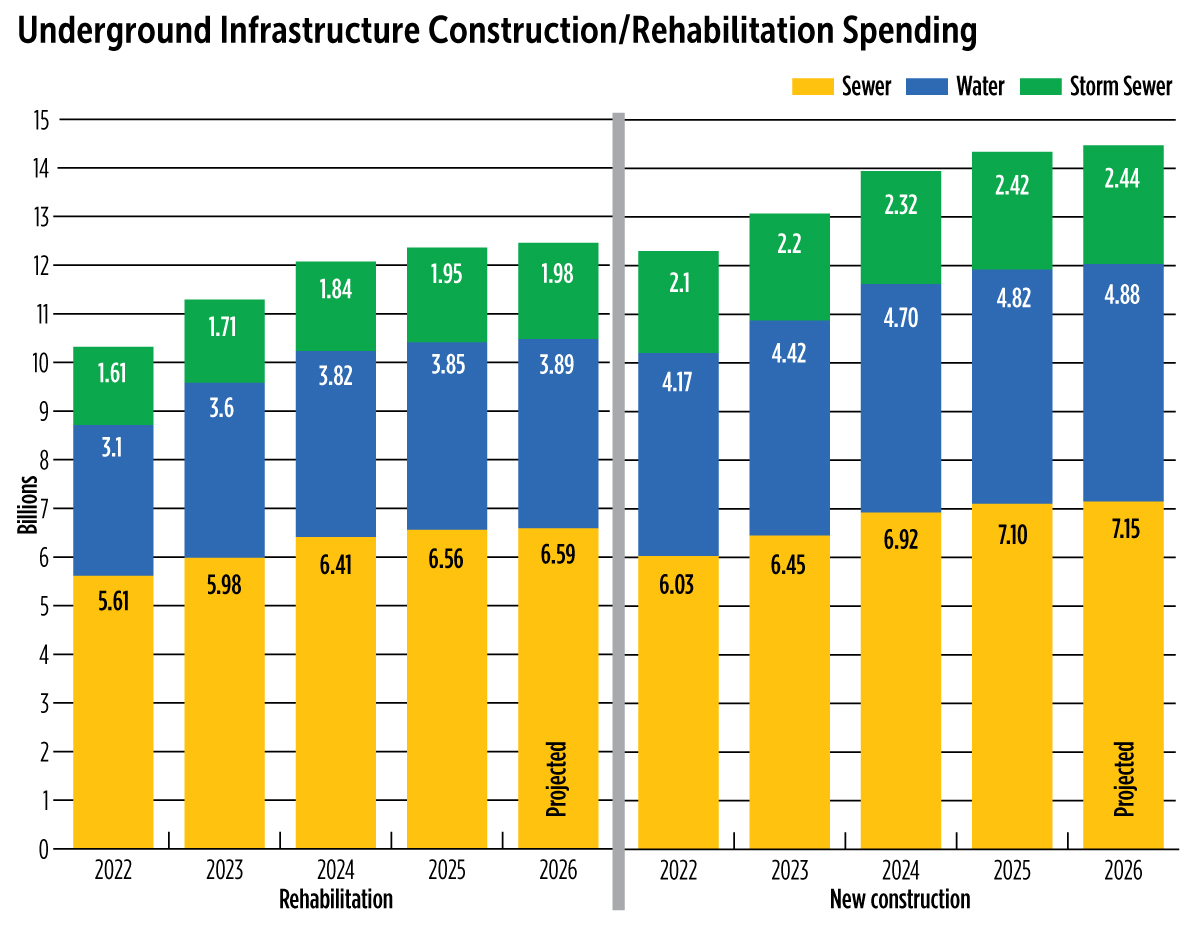
Underground Infrastructure’s analysis anticipates spending in 2026 to increase an additional 1 percent over the 2025 record spending. UI’s data is based on projections from a set number of responses in specific geographical areas by small, medium and large respondents.
The projected 2026 spending of $26.9 billion for both construction and rehabilitation of sewer, water and stormwater systems factors in approximately $6 billion in the final Infrastructure Bill installment, combined with more aggressive spending by municipalities across the country.
Infrastructure Bill
The passage of the famous Infrastructure Investment and Jobs Act in 2021 provided a record $54 billion to sewer/water infrastructure in what was hailed as an incredible opportunity for U.S. municipalities. Always on the low rung of the funding ladder, sewer, water and stormwater projects at last became feasible with the advent of the Infrastructure Bill monies. Spread over five years, the federal funding combined with substantial state investments in a concerted effort to drive strong construction and rehabilitation initiatives across the country.
Now, as the U.S. enters the final year of Infrastructure Bill funding, it remains to be seen if state and local governments will maintain momentum in their efforts to revitalize and repair outdated and neglected systems after this year. While the billions invested via the Infrastructure Bill may seem like an incredible amount – and it is – when compared to the overall spending mountain that will ultimately have to be climbed, the industry still has many mountains to climb. More than $650 billion is estimated to still be needed to update and renovate problem sewer, water and stormwater systems.
Further, it appears that the annual Clean Water and SFR program budgets, which long before the Infrastructure Bill provided essential monies to municipalities, could be cut by as much as 90 percent in the proposed federal appropriations budget, bringing previous funding levels down from billions to $300 million. The justification around Congress seems to be that after providing a funding jumpstart of $55 billion, it is time for local communities and states to absorb maintenance of their systems going forward.
Several states argue that their tax-paying citizens cannot afford that kind of investment without additional federal assistance and would result in their infrastructure continuing its downward spiral. While there is Congressional support to return these programs to their pre-Infrastructure Bill levels, it remains to be seen how that will settle out for 2027 budgets.
Texas initiative
On the other side of the coin is the state of Texas which last summer took a pro-active approach to addressing its needs. Voters approved a constitutional amendment that dedicates up to $1 billion of sales tax revenue per year, from 2027-2047, to the Texas Water Fund for water, wastewater and flood infrastructure projects. Proponents claim this radical funding move allows Texas to remain proactive in ensuring the state’s growing sewer/water/stormwater needs are met.
Several respondents to our survey are excited about opportunities that will continue in Texas for at least the next 20 years. “We expect 2027 to be a big year for us as we expect some major projects to be released,” said this Texas contractor.
Regardless, for 2026, federal spending faucets are still open, states are reinvesting in their cities and most in the survey expect a strong year for the expansion and rehabilitation of sewer and water infrastructure systems.
The largest segment jump in spending is expected to come from a variety of water initiatives, including the continued push to replace all lead water mains and services. While much progress, largely due to recent federal and state mandates, has been made, substantial amounts of lead water pipe remain active in U.S. water systems. It appears that lead pipe replacement will be a driving force for several more years.
The Western U.S. struggles to secure and develop adequate water supplies and along with it, viable water transmission infrastructure. Several major water transportation projects are in various forms of development but most likely will take years to develop, construct and connect with water sources. And water shortages are no longer limited to regions west of the Mississippi River. Municipalities around the country are experiencing various stages of water emergencies. Indeed, running short of water for U.S. cities is an unfortunate reality.
While inflation seems to be somewhat under control in the U.S. and distribution channels are flowing smoothly for the most part, rising prices continue to hit construction and rehabilitation projects. Stretching the dollar to meet project bid costs is an ongoing problem for all parties involved.
Not unexpectedly, for the third year in a row, over 50 percent of the survey respondents report increasing their sewer/water rates, with hikes ranging from 2 percent to as high as 75percent in emergency situations. “We had no choice last year but to increases our utility rates,” lamented a survey respondent from the Western mountain states. “And we’ll probably have to do the same this year.”
Work backlog
The cumulative backlog of work necessary to bring neglected and overworked sewer and water systems up to date is overwhelming, and many survey respondents admit increasing rates is a regular necessity. UI’s Municipal Survey reports that rate hikes are now occurring at least every two-to-three years.
Further, as cities steadily try to update or expand their systems, finding the funds remains a top issue. Identifying and obtaining various types of traditional and innovative project funding is a key to new projects, reported several survey respondents. “Most of our funding is standard stuff, but our consultants have identified some angles we never pursued before,” reports this municipal manger from the Northeast. “We’ll certainly consider various funding options to avoid system failures.”
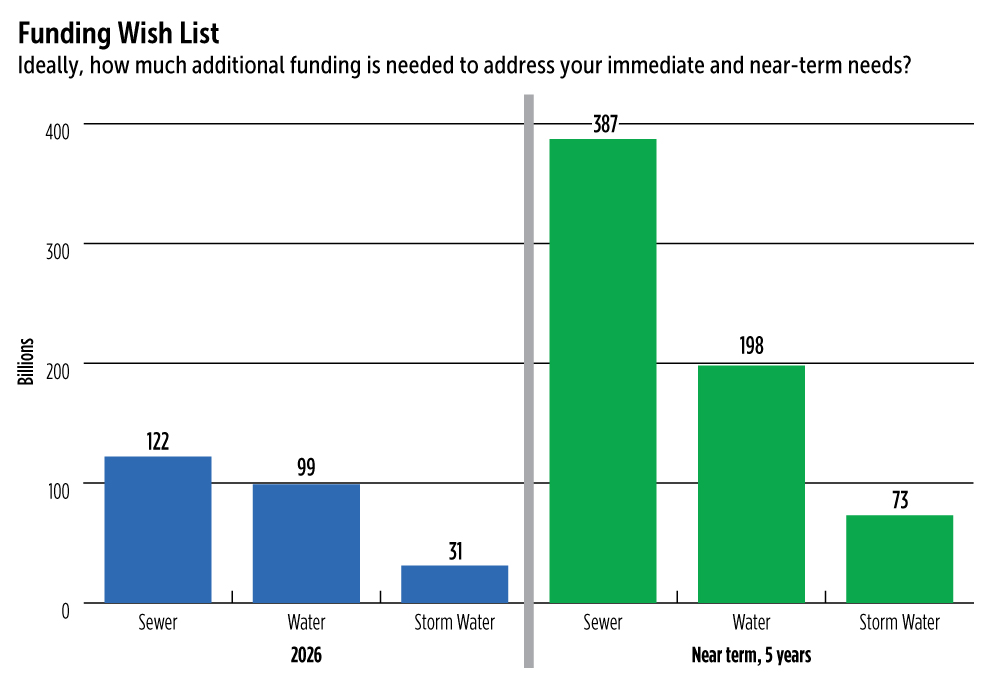
The bottom line is that funding never seems to be enough to meet the many system needs for municipalities. City personnel were asked to put a price tag on their immediate funding needs to address glaring system issues. Respondents believe they would need roughly $122 billion for sewer, $99 billion for water and $31 billion for stormwater. When asked the same question but for five years or more, the amount increased to $387 billion for sewers, $198 billion for water needs and $73 for storm sewers.
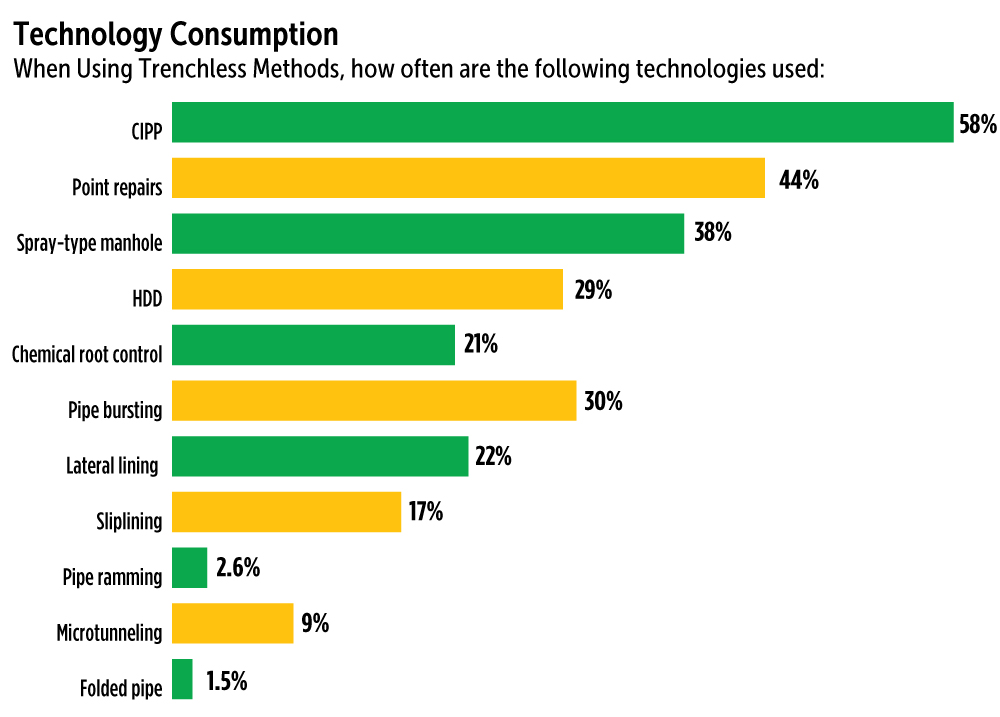
The percentage of those surveyed who said they prefer trenchless methods remained relatively constant at 46 percent. A slight increase was noted for those who have no preference, as to open-cut or trenchless, coming in at 41.2 percent.
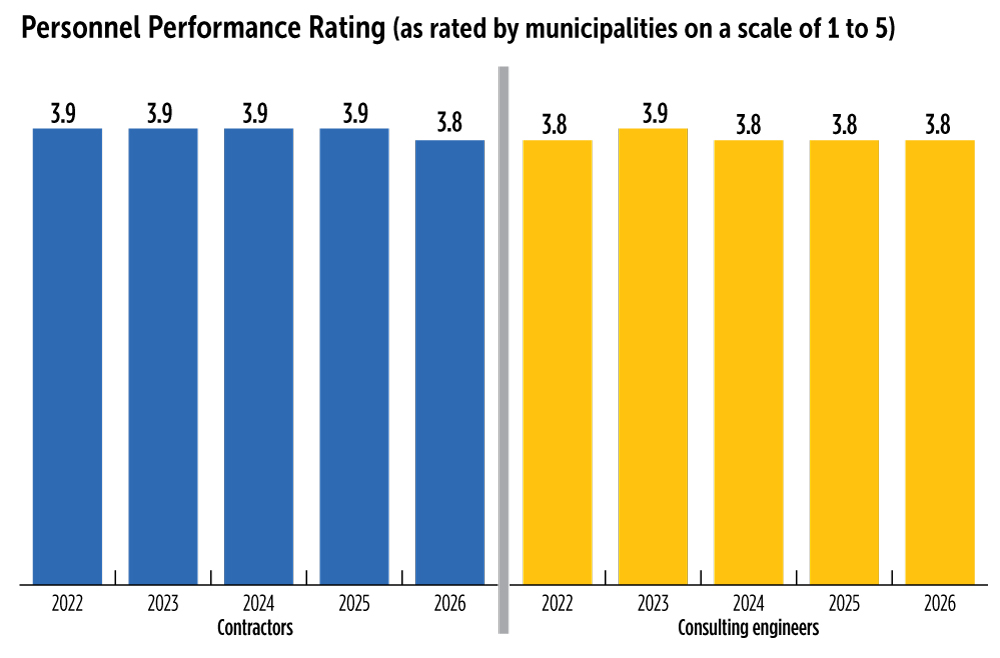
The survey also asked municipal personnel to rate the consulting engineering community based on the 1-to-5 scale, with five being the highest approval rating. Basically, this number provides a confidence benchmark. The consulting engineer score remained stable with a 3.8 score for the third year in a row.
For the most part, respondents were pleased with the efforts of consultants. Asked about how engineers could increase their relationship and effectiveness with cities, “quality” again stood out, with 79 percent citing that factor. Other areas included “understanding of new technology” (77 percent of respondents), “cost” (66 percent of respondents), and “productive relationships with contractors” (47 percent).
The survey also asked municipal personnel to rate contractors. The overall rating was a composite from four categories: quality of work, timely project completion, fair pricing and dependability, based on a scale of one (worst) to 5 (best). Contractors saw their composite score fall slightly to 3.8.
Like engineers, quality was the number one desired trait for contractors, cited by 84 percent. On-time project completion was also highly coveted by 74 percent of respondents.

Comments