


March 2026 Vol. 81 No. 3
Features
High desert HDD bore tests precision under Deep Creek bridge
(UI) — In Southern California’s High Desert, ground conditions rarely stay consistent for long. Wind scours it down to dust, heat hardens it by day and cooler nights loosen everything overnight. What looks solid one moment can collapse the next, turning routine work into a test of planning, patience and experience.
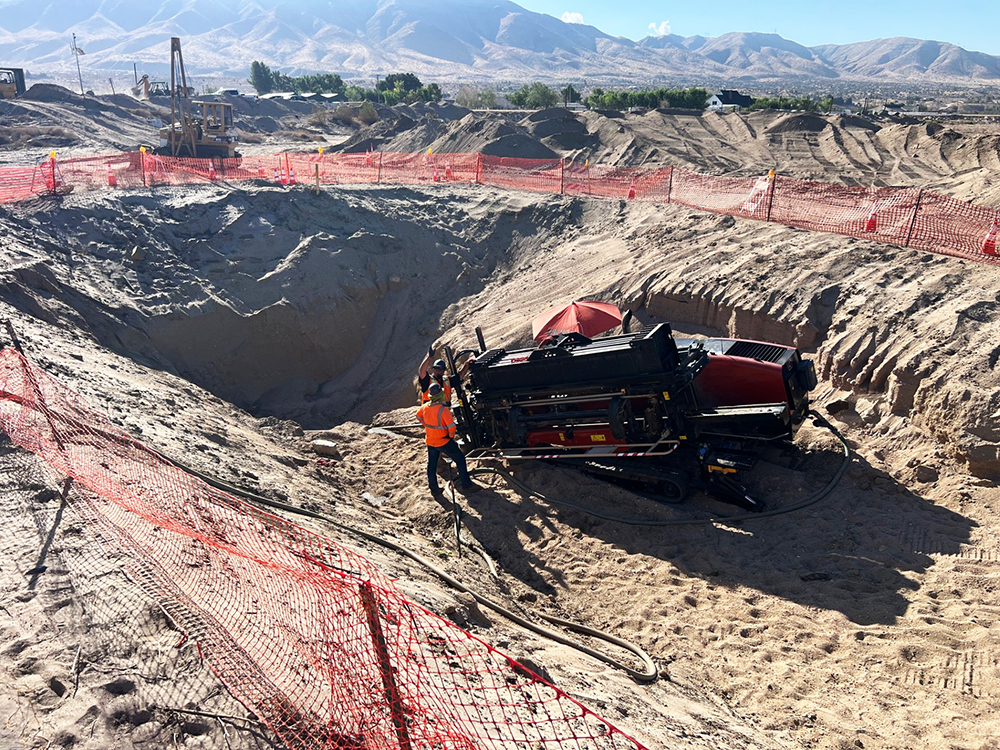
For Advantage Directional Drilling, that unpredictability is routine. The company has built its reputation working in terrain where precision is required and errors carry real consequences. That reality came into sharp focus during a gas line relocation beneath the Deep Creek bridge, where shifting conditions and unexpected interference demanded not only careful execution, but dependable equipment and reliable dealer support.
“This wasn’t a job you could just drill and hope,” said Johnny Torres, superintendent and driller for Advantage Directional Drilling. “We had to be spot on.”
Advantage Directional Drilling was founded in 2004 by Ralph Torres with a Ditch Witch JT520 and a willingness to take on challenging work. From the beginning, the company operated with disciplined planning and a close working relationship with Ditch Witch West, a partnership that became part of its operating model.
Today, the company runs lean crews by design. A typical setup includes three team members: an operator, locator and a third contractor training to handle both roles.
“The point is flexibility and accountability,” Torres said. “Everyone learns the whole job, not just one piece of it. That is how you stay sharp.”
That same consistency extends to equipment. Advantage operates exclusively with Ditch Witch drills and Subsite locating systems. What started with a JT520 has progressed to larger machines, including a JT30 that has logged extensive hours in High Desert conditions.
For Advantage, that commitment reflects more than preference. Reliability and accuracy are central to how the company works. Locating systems are critical to maintaining precise bore data in regulated utility work.
“When the signal drops or the job hinges on a split-second call, uptime and quick support can mean the difference between moving forward and losing a day,” Torres said.
Deep Creek brings deeper demands
Beneath Deep Creek, one of only two creeks in the United States that flows south to north, a straightforward gas line relocation quickly grew more complicated.
On paper, the assignment was straightforward. Shift an existing gas line 25 feet to clear space for a new bridge. Below the surface, the bridge carried more than traffic. Its bones were reinforced with steel, and the surrounding soil was sugar sand that moved as easily as it gave way.
The original plan called for two 400-foot bores tied together at depth. But clearing the structure required dropping deeper than the ground would safely tolerate. A tie-in with collapsing sand was not a risk the crew was willing to take.
Advantage committed to a single, continuous drill-and-pull. No potholing. No shortcuts.
The entry pit was excavated 10 feet deep and carefully shored. From there, Torres set a 2-percent grade, targeting nearly 20 feet beneath the bridge while maintaining a line steady enough to pull eight-inch steel.
“Once drilling started, there was very little room to adjust,” he stressed.
WATCH NOW: Deep Creek Drill a High-Stakes Bore
When the signal went silent
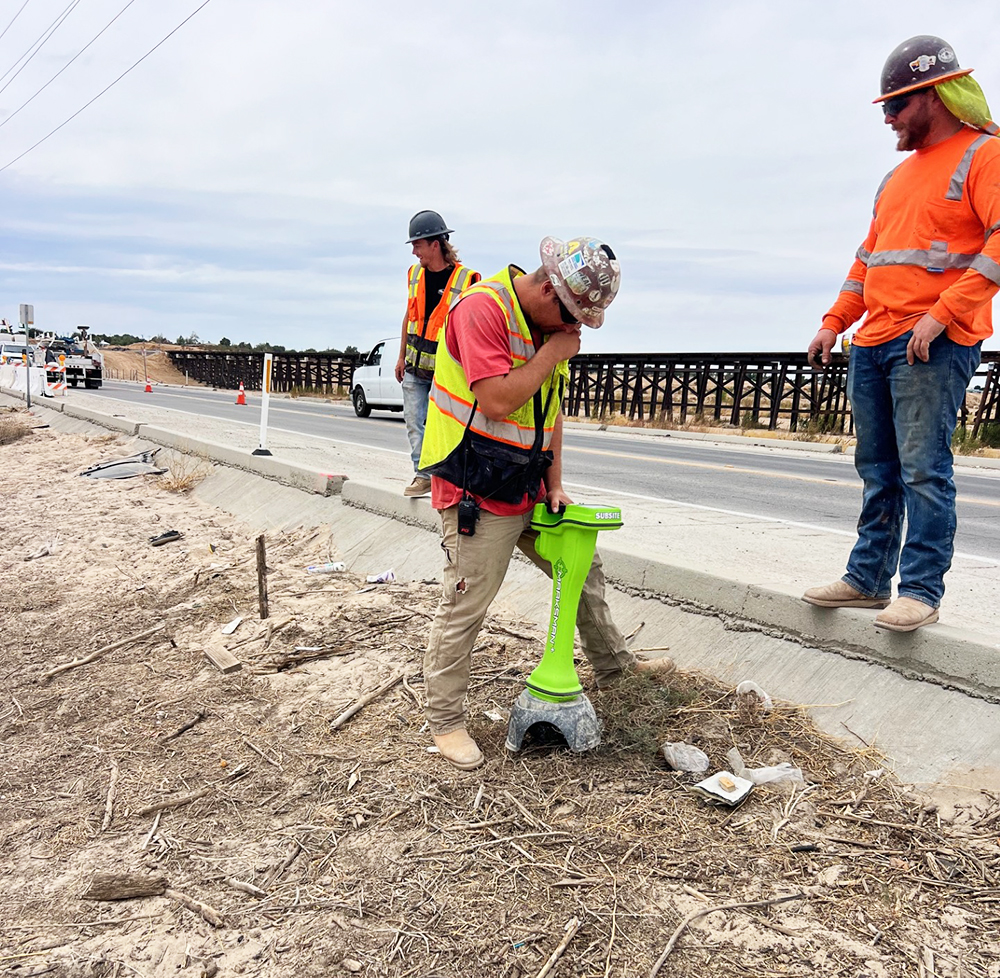
Before the first rod turned, Torres asked Andy Taminich from Ditch Witch West to walk the bore with him. Together, they reviewed the bore path, discussed locator frequencies and focused on the final stretch beneath the bridge approach.
The first 700 feet moved without incident. The drill held grade. The Subsite locator read clean. Then, as the bore reached the bridge at nearly 20 feet deep, the signal went silent.
Reinforcement within the structure scattered the locator’s frequencies, bending pitch, angle and depth into unreliable numbers. Coming up shallow could compromise the pipe. Surfacing in the wrong place could end the project.
“In California, accuracy is nonnegotiable,” Torres said. “Bore data is trusted, and mistakes carry consequences far beyond a single project. This was the critical part of the bore, and we had to do it right.”
Wireline locating was an option, but it would have stalled the job when momentum mattered most.
“Wireline would’ve solved it, sure,” Torres said. “But time kills margins. What we needed was the kind of support where you can make a call, have someone show up, walk the job with you and help you find a better way.”
Torres reached back out to Ditch Witch West. Taminich returned and worked alongside Torres while contacting Subsite support. Together, they tinkered through available frequencies, knowing interference behaves differently depending on depth and surrounding material.
They tried 46. Then 21. Then 15. Nothing. Then a faint reading surfaced, like a signal pushing through static. When they switched to 3.5, the locator stabilized, and pitch and angle came back into view.
Torres said. “That’s when we knew we could keep moving.”
Depth readings were imperfect but workable. Torres relied on grade calculations and discipline. Advance slowly. Confirm what could be confirmed. Keep the line honest.
When the drill head surfaced, it broke ground exactly where it needed to. “It was one of those good days,” Torres said.
Only after the crossing was complete did the full picture emerge. The interference was not typical rebar alone, but heavy bridge reinforcement, a dense grid of quarter-inch steel filled with fiberglass. Together, it formed an underground shield that deflected locator signals in every direction.
“The signal was ricocheting in every direction and scattered every frequency we tried,” Torres said. “Once we saw what was beneath, it all made sense.”
The gas main was safely relocated beyond the footprint of the future bridge. The customer was satisfied. The bore data held.
Support in motion
The Deep Creek bore stretched nearly two weeks from punch hole to pullback. Pre-reaming moved slowly as sugar sand resisted hole retention, demanding constant attention to stability. By the time the 8-inch steel was in place, the crew had gone through 12 pallets of drilling fluid, each one part of protecting the line and preserving the integrity of the crossing.
That level of discipline does not exist in isolation. It is reinforced by the relationships Advantage Directional Drilling relies on every day.
Midway through the project, Torres realized the 600 feet of drill pipe onsite would fall short of completing the 800-foot run. A call to Ditch Witch West set the response in motion. An additional 300 feet of drill pipe arrived the same day, keeping the schedule intact.
The pattern has repeated on other jobs. When an 8-inch downhole tool raised concerns after contacting rock, Torres again reached out to Taminich.
“Andy tracked down the correct tooling in Texas, and had it delivered on a Saturday,” Torres said. “No questions asked.”
For Torres, that responsiveness changes how decisions are made in the field. It removes hesitation at critical moments and allows the crew to stay focused on execution, knowing help is already on the way.
Out in the High Desert, the ground keeps its secrets. Sand shifts. Steel hides. Signals disappear without warning. What looks steady at sunrise can unravel by noon.
For Advantage Directional Drilling, certainty is not something uncovered by accident. It is built long before the first rod turns. It lives in morning calibrations and grade calculations, in disciplined crews knowing that depth matter and documentation must hold.
“I never take depth for granted,” Torres said. “Accuracy can save lives.”
Beneath Deep Creek, the crossing was measured in more than feet of depth. It was measured in preparation, in trust built over time, and in equipment and partnerships strong enough to hold when the ground would not.
FOR MORE INFORMATION:
Advantage Directional Drilling, (760) 948-7069, advantagedirectional.com
Ditch Witch, Ditch Witch - Underground Construction Equipment
Ditch Witch West, Trenching Equipment Sales, Services, & Rentals | Ditch Witch West
Subsite Electronics, Subsite Electronics

Comments