


June 2026 Vol. 81 No. 6
Features
Omaha ramps up water main replacement with HDD and HDPE pipe
(UI) — Omaha's Metropolitan Utilities District, known as M.U.D., is living up to its acronym more and more each day. It's increasing the amount of work done in the dirt to provide some 600,000 people with reliable drinking water, improving the city's infrastructure.
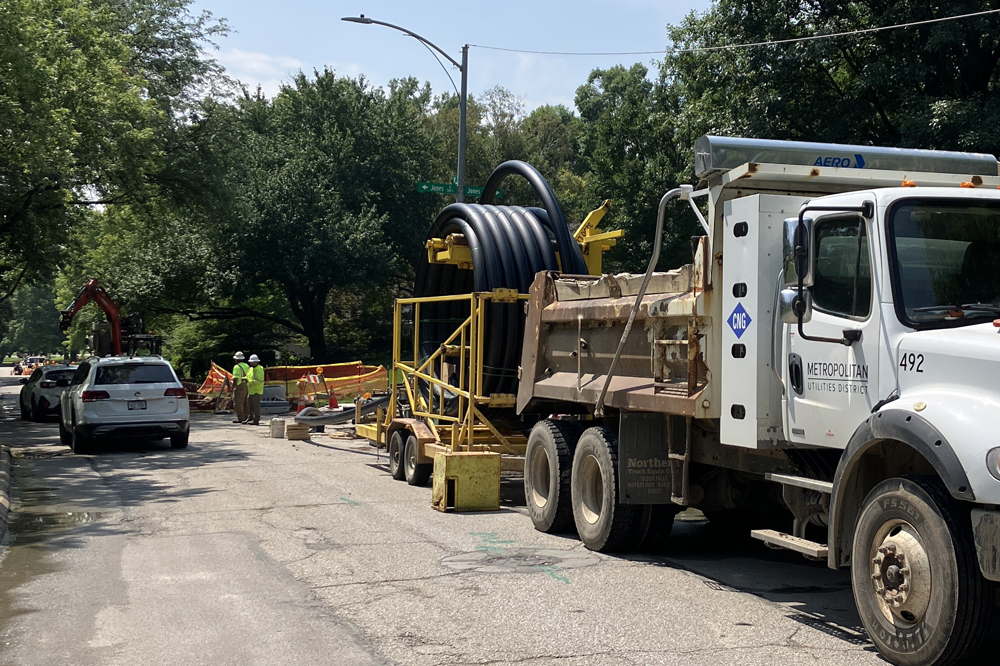
Just three years ago it started to replace cast iron lines by installing high-density polyethylene (HDPE) pipe using horizontal directional drilling (HDD) and pipe bursting. Averaging 10 miles a year from 2016 to 2019, M.U.D. has continually increased its efforts and is now tracking to hit 17 miles a year as it pursues a goal of replacing the highest-risk water mains in its system.
"Our long-term goal is to increase our replacement mileage to a more sustainable level to reduce water main breaks in our system," explained Derek Duin, M.U.D. senior infrastructure engineer. "The thought process behind that is if you're always replacing a percentage of our system, we'll always be within the designed lifespan of the pipe material."
The Metropolitan Utilities District owns and operates three water treatment facilities that can supply more than 300 million gallons of potable water daily – more than enough to meet the peak summer demands that can reach 180 million gallons a day. Its water sources include the Missouri River and wells along the Platte River, west and south of the city.
The Infrastructure Integrity Department uses risk modeling that takes into account several factors to prioritize water mains needing replacement, with areas having the highest percentage of breaks being targeted first. Some of its cast iron mains are more than 100 years old. M.U.D., however, is focusing on spun cast iron from the 1940s, along with other mains installed during the last mid-century that are deteriorating because of corrosion. Along with 3,200 miles of distribution mains, the utility maintains more than 29,000 fire hydrants and provides natural gas to 245,000 customers.
One of M.U.D.'s high-priority water main replacement projects was near 94th and Shamrock Road just west of downtown Omaha after another pipeline fracture. There had been more than 25 breaks in the cast iron line since it was installed in the mid-1960s.
"In this particular neighborhood, it was primarily corrosion holes just in the body of the pipe," Duin explained. "They're not super high, but the pressures run about 100 to 120 psi in this area. When we are getting these holes, there is potential to release quite a bit of water with the decent pressure behind those corrosion holes. It's just this whole area where the old pipe has been breaking fairly frequently, so we decided to just go finish out the rest of this neighborhood."
Replacing the cast iron pipe in this neighborhood called for 5,600 feet of 6-inch diameter PE4710 HDPE DIPS DR 11 pipe to be horizontally directionally drilled. Coming on reels with 450 feet of pipe allowed for a smaller staging area, most times right on the street or between the sidewalk and curb. Using a Ditch Witch JT32 with 32,000 pounds of pullback, the longest pull was 680 feet.
"The reels of pipe were really nice for us because that's a pretty standard bore shot," Duin stated. "You're shooting from hydrant to hydrant or tee to hydrant, which in residential areas, our spacing requirement is 500 to 600 feet. We have some open trenching around sewers and for our connections, but the majority of it is being bored in. It really is quite nice. It's been working out well."
The M.U.D. crew used electrofusion saddles to make connections and transition to a valve and use MJ adapters for connecting to a fire hydrant.
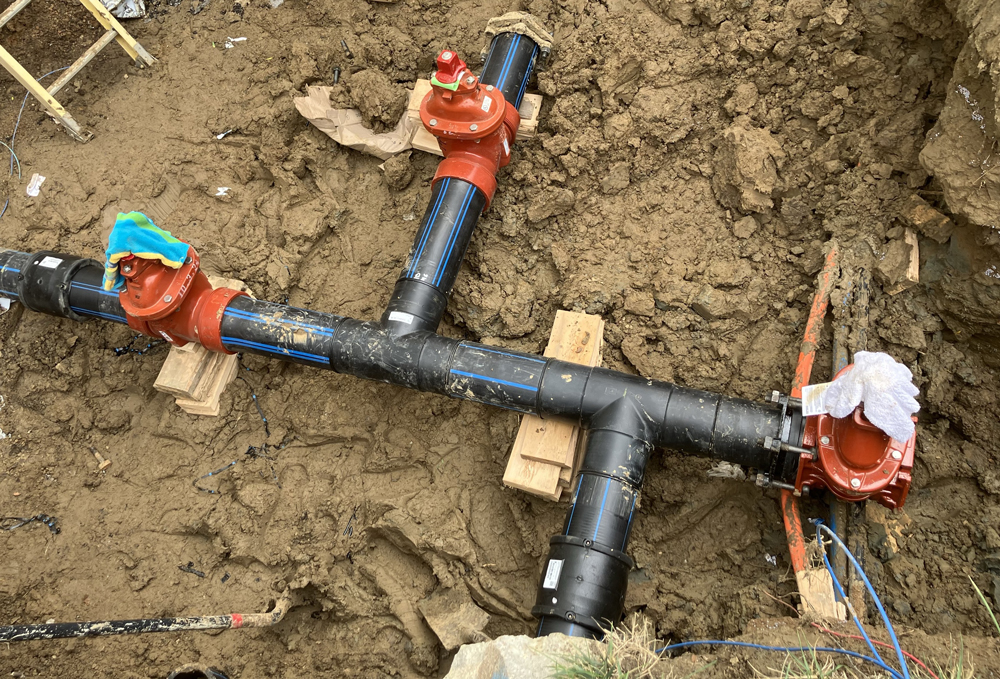
"This was our first use of reeled HDPE on a potable water main project, which significantly reduced fusion time and minimized disruptions to customers," Duin explained. "The project also marked a key step toward our goal of implementing a fully fused system. With the exception of MJ (mechanical joint) adapters for hydrant branches due to right-of-way space constraints, the design was fully fused – enhancing overall system strength and reliability. This effort has helped advance our HDPE material standards and installation practices for future projects."
"The science and technology for using HDPE pipe have been well-proven and thoroughly documented in all the HDPE AWWA Standards C901, and also in the AWWA M55 PE Pipe Design and Installation Manual," stated Camille George Rubeiz, P.E., F. ASCE, co-chair, HDPE Municipal Advisory Board, and vice president for the Plastics Pipe Institute's (PPI) Municipal & Industrial Division. "HDPE pipe has many benefits including trenchless construction, a fully restrained join-free system, excellent flow capacity, longevity, zero allowable leakage, plus resistance to fatigue, ground movements, seismic and corrosion, and is designed and built for water and wastewater applications meeting the latest AWWA and ASTM standards.
"Heat fusing sections of the pipe, whether coiled or stick, provide a leak-free pipeline, preventing both infiltration of fines and also exfiltration of water. Plus, the use of electrofusion fittings and saddles and also the mechanical joint adaptor for fire hydrants as is being done in Omaha also provide a secure line while being very efficient to install, cutting labor and installation time."
The Plastics Pipe Institute is a major North American trade association representing the plastic pipe industry. As part of its Municipal & Industrial Division, the HDPE Municipal Advisory Board (MAB), an independent, non-commercial advisor to the division, helps to improve the design, installation and operation of municipal HDPE water piping systems. "We are very fortunate to have the Metropolitan Utilities District as an active member and utility leader within our HDPE Municipal Advisory Board," stated Rubeiz.
The depth for the HDD pulls was 5 to 6 feet and were constructed by one of two M.U.D. crews with six people in each who are trained and dedicated to the M.U.D. Water Infrastructure Replacement Program. Outside contractors are also used on occasion.
"We've done about 20 miles worth of HDD work in the past two years. Our internal crews have done about seven of those miles. Now we probably do 35 to 40 percent of the installation work with our internal crews, and the rest gets contracted out," Duin said. "We're trying to increase the miles that we install internally. We have plenty to do."
With trained crews and outside contractors, M.U.D. has set the stage for the future.
"A continuous program is the plan," Duin continued. "In terms of what's next? Right now, we're replacing 17 miles a year with a goal to increase to 18 miles in 2027.
"We're really focused on making sure that we're putting a product in the ground that can last for more than a hundred years, finding new installation methods, finding the longest lasting materials, and ways to speed up the crews so that we can ultimately increase our replacement goals in the future. From there, the hope is to be on autopilot, have a recurring program that we like the materials that we're using, we like the crews that we have, we like the contractors that we have, and we just keep on replacing.
"I would say everyone's happy with the plan. For homeowners and businesses, if you talk to them, a planned project is far more appetizing than a water main break," Duin observed.
For more information
- Ditch Witch: ditchwitch.com
- Plastics Pipe Institute: plasticpipe.org/mabpubs

Comments