


June 2026 Vol. 81 No. 6
Features
Five questions to ask when selecting stormwater management pipe
By Jonathan Sickels
(UI) — Designing an effective stormwater management system requires more than specifying pipe diameter and slope. The long-term success of any underground system depends on how well the selected materials perform throughout construction, over decades of service and under increasingly variable environmental conditions. Asking the right questions early, before materials are finalized, can help project teams avoid downstream risks, construction challenges and avoidable costs.
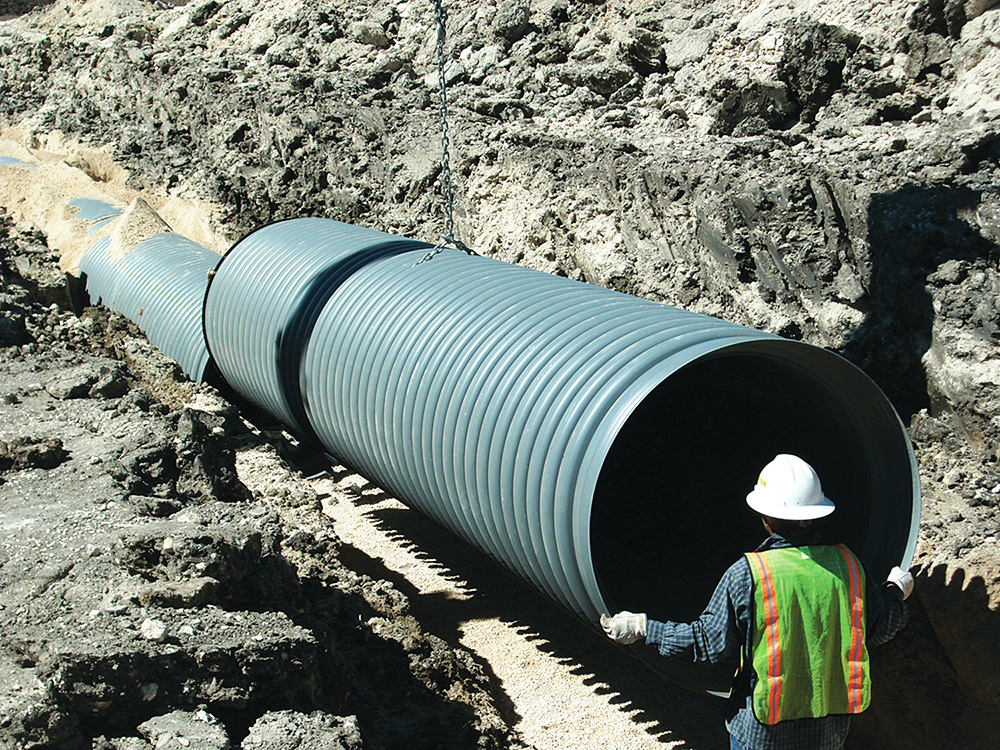
When evaluating stormwater pipe, a deliberate, performance-driven approach leads to better outcomes. The following five questions can help designers, engineers and owners make more informed, resilient and sustainable decisions.
How reliable are the pipe joints over the life of the system?
Stormwater management pipe is typically manufactured to be strong and durable. However, every stormwater management system is only as reliable as its joints. These connection points where two sections of pipe meet are inherently more vulnerable points in any pipeline and deserve careful scrutiny.
Watertight joint systems are critical to preserving subgrade stability and preventing soil migration. Their performance should be clearly defined in project specifications, not assumed based solely on pipe material. When water is allowed to pass through or around joints, it can transport fine soil particles away from their original location, creating voids at or beneath the pavement surface.
Over time, these voids can lead to settlement, sinkholes and other forms of pavement distress that significantly compromise structural integrity. Loss of subgrade support can also result in pipe settlement, misalignment or system failure. By specifying verifiable joint performance requirements, designers can reduce the risk of both soil intrusion into the pipe and backfill extrusion into surrounding voids, helping ensure long-term system reliability.
What is the design service life of the project?
Stormwater management systems are long-term infrastructure assets, often expected to perform reliably for 100 years or more. However, the conditions these systems must now withstand are materially different from those faced by systems designed decades ago. Meeting future infrastructure demands will require moving beyond the assumption that approaches and materials used over the last century will continue to be sufficient.
Evaluating durability and service-life performance in this broader context is essential to delivering resilient, sustainable stormwater systems. Pipe should not be selected simply based on historical precedent. Its demonstrated ability to perform under project-specific conditions for the full design life of the asset needs to be considered.
In many cases, this requires consideration of innovative materials, advanced manufacturing methods and system designs that offer improved resistance to known degradation mechanisms. For installations in particularly aggressive environments, designers are encouraged to engage with suppliers early and request documented performance history or testing data to substantiate long-term durability claims and support informed, forward-looking decisions.
How well does the pipe accommodate installation and constructability requirements?
Evaluating constructability during design helps ensure that assumptions made on paper align with real-world field conditions and reduces the risk of installation-related issues. Project specifications should clearly define installation requirements consistent with the pipe material being used, as proper installation is critical to achieving expected performance and service.
Constructability factors such as handling, transportation and installation efficiency should be carefully considered during design. Pipe systems that are easier to handle may allow for faster placement, simpler alignment adjustments and reduced reliance on lifting equipment, depending on site conditions. These attributes can contribute to improved job-site safety, lower construction risk and reduced schedule disruption, particularly on constrained or accelerated projects.
Pipe length is another important constructability consideration. Longer pipe sections reduce the total number of individual pieces that must be installed, which can improve productivity and simplify installation sequencing. Fewer sections also mean fewer joints in the system, which not only streamlines construction but helps reduce potential pathways for soil migration, supporting long-term system performance.
To ensure these constructability benefits translate into long-term system performance, installation practices should be clearly specified. They should also be aligned with applicable industry standards, such as ASTM D2321 for thermoplastic pipe installations and ASTM C1479 for reinforced concrete pipe installations.
What is the total installed cost of the system?
Once multiple pipe options are identified that satisfy the structural and hydraulic requirements of the project, evaluation should move beyond initial material suitability to consider total installed cost. Focusing on installed cost allows decision-makers to better understand the full economic impact of each alternative rather than relying solely on unit price comparisons.
In addition to material cost, total installed cost may include installation labor, equipment and lifting requirements, transportation and handling, and anticipated maintenance over the service life of the system. Systems that can be installed more efficiently, using fewer crews, fewer joints and less intensive construction operations, may offer advantages in both construction cost and schedule reliability. Repair and replacement considerations should also be assessed as part of a long-term asset management perspective.
Taking this broader view helps ensure projects remain within budget while minimizing lifecycle risk and delivering sustained value to owners.
Can the provider of the pipe be a strategic partner?
It is important to take a strategic approach to pipe selection, which means working with a provider who has the capabilities, expertise and insight to be that strategic partner. The provider should have experts on hand who can help identify design requirements and create a site-specific solution. This includes not only considering codes and standards, but also site constraints, preferences of communities, soil characteristics, pollutant load, water flow and area rainfall. These experts can take a macro-level view of these factors to ensure the goal of the project is feasible and to determine what type of stormwater solution would best meet that goal.
Engaging a pipe supplier in the pre-planning phase can provide a valuable opportunity to explore new options and technologies that are available. It can also help eliminate costly instances where changes or a different solution needs to be shoehorned into a project after most of the design has been completed. Some stormwater solutions providers even have hydraulics testing facilities where they can replicate real-world stormwater conditions and scenarios under controlled conditions.
Selecting the right pipe for a stormwater management project comes down to asking the right questions and evaluating the answers within the context of project requirements. Asking these five important questions helps ensure project teams make informed decisions that lead to more durable, sustainable and cost-effective stormwater management systems.
About the author
Jonathan Sickels, based in Austin, Texas, is vice president of public markets at Advanced Drainage Systems. His 25 years of experience with ADS has led to ever-increasing roles of responsibility.
For more information
Advanced Drainage Systems: adspipe.com

Comments