


Natural Gas Pipeline Projects Increase U.S. Transportation Capacity
By U.S. Energy Information Administration
From November 2020 through January 2021, approximately 4.4 billion cubic feet per day (Bcf/d) of new natural gas pipeline capacity entered service, according to the U.S. Energy Information Administration’s (EIA) Natural Gas Pipeline Project Tracker.
Four projects have recently been completed and entered service:

Saginaw Trail Pipeline
Consumer Energy’s $610 million intrastate Saginaw Trail Pipeline entered service in late November 2020. The project replaced and expanded natural gas pipelines and infrastructure in Saginaw, Genesse, and Oakland Counties in Michigan, increasing natural gas capacity by 0.2 Bcf/d.
Buckeye Xpress Project
Columbia Gas Transmission’s (CGT) 0.3 Bcf/d Buckeye Xpress Project began operations in December 2020. The $709 million project involved infrastructure improvements and replaced 66 miles of existing natural gas pipeline with more reliable 36-inch pipe in Ohio and West Virginia. The project increases transportation capacity out of the Appalachia Basin into CGT’s interconnection in Leach, Kentucky, and the TCO Pool in West Virginia.
Permian Highway Pipeline
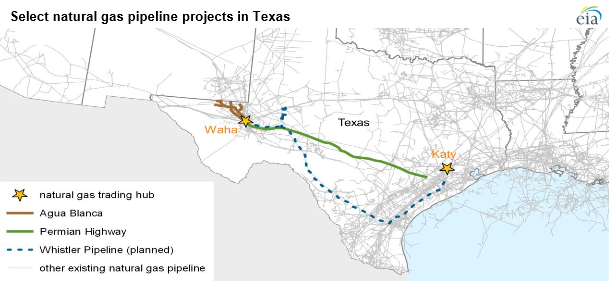
Kinder Morgan’s Permian Highway Pipeline (PHP) entered service in early January. The 430-mile pipeline brings 2.1 Bcf/d of additional natural gas capacity from the Waha Hub, located in West Texas near production activities in the Permian Basin, to Katy, Texas, near the Gulf Coast. It has additional connections to Mexico.
Agua Blanca Expansion Project
Whitewater/MPLX’s Agua Blanca Expansion Project, which entered service in late January, connects to nearly 20 natural gas processing sites in the Delaware Basin. It transports an additional 1.8 Bcf/d of natural gas to the Waha Hub in West Texas. The project will also connect with the Whistler Pipeline, which is scheduled to be completed in the third quarter of 2021 and is expected to move 2.0 Bcf/d of natural gas from the Permian Basin to the Texas Gulf Coast.
In December, Tellurian withdrew its application to build the Permian Global Access Pipeline in Texas and Louisiana, effectively canceling the project. The proposed 2.0 Bcf/d project would have transported natural gas from the Permian Basin to a proposed liquefied natural gas (LNG) facility in Gillis, Louisiana.
EIA’s Natural Gas Pipeline Project Tracker and the Liquids Pipeline Projects Database provide information about important natural gas and petroleum infrastructure in the United States. EIA updates its Natural Gas Pipeline Project Tracker quarterly, based on the best available information from pipeline company websites, trade press reports, and government documents. These data reflect reported plans. These resources are not forecasts and do not reflect EIA’s assumptions on the likelihood or timing of project completion.
Related News
From Archive

- EIA: Texas to lead U.S. pipeline construction activity through 2027
- Oil pipeline struck during fiber optic construction spills into L.A. storm drains
- Utility strike at center of Dallas explosion investigation
- Gas line strike destroys three homes in Ohio neighborhood
- $1 billion Ohio River Tunnel project awarded in Pittsburgh
Comments