


San Diego's North Park neighborhood celebrates undergrounding of power lines
(UI) — The North Park neighborhood in San Diego, Calif., recently celebrated a significant milestone as they witnessed the removal of overhead power lines from their community, Times of San Diego reported.
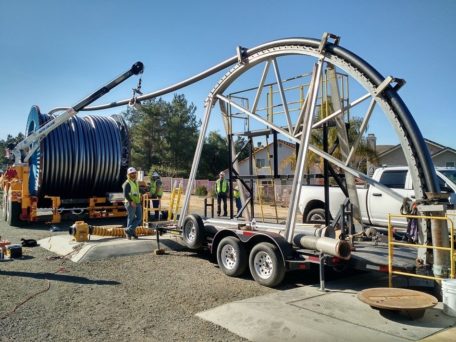
The event, held at the intersection of Howard Avenue and Illinois Street, saw residents and representatives from the city and San Diego Gas & Electric (SDG&E) gathering to witness the safe dismantling of one of the final standing utility poles in the vicinity.
In a joint effort, the city and SDG&E are working together to transition approximately 15 miles of overhead wiring underground annually throughout the entire city.
“We are proud to partner with the city to accelerate the undergrounding of our utilities for the benefit of the families and businesses we collectively serve,” SDG&E Director of Design and Project Management Erika Schimmel-Guiles told Times of San Diego. “We have more work to do and look forward to our continued partnership with the city.”
The city allocates around $54 million annually to convert overhead power and communication lines, contributing to the enhancement of local communities' aesthetics and the reduction of power outages, according to Times of San Diego.
Improved public safety, visual appeal, and the overall reliability of essential utility systems were highlighted by San Diego City Council member Stephen Whitburn, who told Times of San Diego, "The undergrounding in North Park will improve public safety and aesthetics as well as the overall reliability and resilience of our critical utility systems."
The process of eliminating overhead utility lines involves meticulous coordination and planning with various entities, residents, and homeowners. While some utility poles may remain to provide additional services such as cable or internet, the undergrounding initiative aims to mitigate power outages, often caused by vehicular collisions with electrical equipment.
Funding for municipal undergrounding initiatives comes from diverse sources. City of San Diego residents contribute to the effort through a surcharge on their SDG&E bills, approved in 2002. Residential customers, on average, allocate $5 to $8 each month on their SDG&E bills to accelerate the undergrounding process. These funds are then channeled to the city, which reimburses SDG&E for design and construction expenses based on a city-approved priority list.
SDG&E remains dedicated to supporting undergrounding initiatives wherever feasible, with approximately 60% of the utility's distribution system already underground. However, challenges in certain regions, such as topography and other logistical issues, make undergrounding both expensive and impractical.
Related News
From Archive

- EIA: Texas to lead U.S. pipeline construction activity through 2027
- Oil pipeline struck during fiber optic construction spills into L.A. storm drains
- Utility strike at center of Dallas explosion investigation
- Gas line strike destroys three homes in Ohio neighborhood
- $1 billion Ohio River Tunnel project awarded in Pittsburgh
Comments