


May 2026 Vol. 81 No. 5
Features
Alberta’s Northwest Coast oil pipeline proposal weighed; critics express concern
By Gordon Feller, Contributing Editor
A newly proposed Alberta Northwest Coast Oil Pipeline project has an estimated capacity exceeding 1 million barrels of oil per day, delivered to a strategic deepwater port on British Columbia's northwest coast. When it’s finalized, the project’s formal submission will include a general path and size for the pipeline. Specific routing and technical specifications have not been finalized.
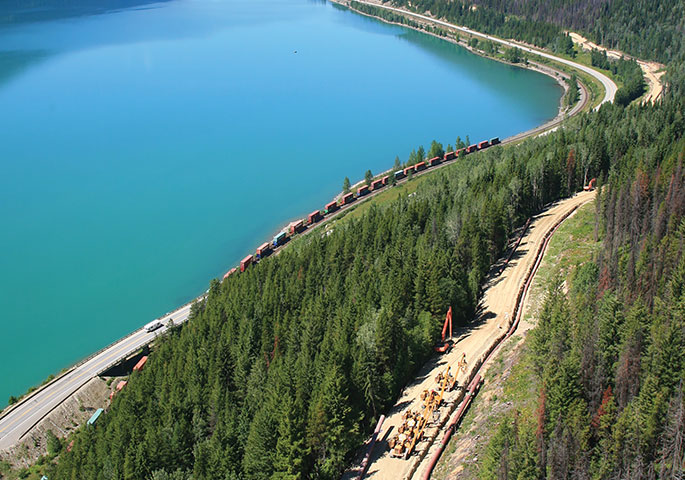
Alberta’s provincial government is acting as the initial proponent during early planning stages. It argues oil and gas demand will remain strong for decades, especially in Asia. Target markets include Japan, Korea, China and India. The government’s primary goal is to diversify away from dependence on U.S. markets.
"Net export receipts of crude oil have climbed from C$6 billion in 2000 to C$130 billion in 2024.” However, the Canada Energy Regulator (CER) reported that the total value of crude oil exports was US$100.7 billion in 2024 – which would be approximately C$138 billion at 2024 exchange rates.
The pipeline’s application will be ready to submit to federal Major Projects Office on or before July 1, 2026. The project is seeking designation as a “project of national interest” under the Building Canada Act. The federal government in Ottawa and the Alberta government aim to ensure that project approvals are completed within two years.
Alberta's government says that it will contribute C$14 million to support early planning work including preliminary engineering, cost estimates, economic modelling and early engagement. Previous estimates for similar projects showed potential for C$3.8 billion in total annual government revenues across Canada, with a promise of 800,000 jobs over the project’s full lifetime. This project would require billions of dollars in private investment, if approved. Once project planning is complete, the expectation is that private sector will take over project development.
Indigenous ownership and equity are integral to the project – with co-ownership as a core principle. The Alberta Indigenous Opportunities Corporation says that it’s ready to support Indigenous co-ownership. The project’s leaders are proposing that Federal and provincial loan guarantees be made to support Indigenous co-ownership, through the Canada Indigenous Loan Guarantee Corporation and Alberta Indigenous Opportunities Corporation.
This pipeline’s advocates say it will use “innovative technology to exemplify best-in-class performance,” and it “will include rigorous safety protocols, advanced monitoring systems and fail-safe engineering practices.” It “will comply with mandatory pilotage, tug escorts and restricted navigation zones for marine safety.”
Furthermore, to reduce emissions intensity, carbon capture and storage technology will be incorporated and linked to the Pathways carbon capture project. Three companies are participating in the project’s technical advisory group: South Bow, Enbridge and Trans Mountain.
Opposition
Critics of Alberta's proposed Northwest Coast Oil Pipeline oppose the project on Indigenous sovereignty grounds, climate and environmental concerns, economic viability questions and concerns about provincial jurisdiction. The opposition spans Coastal First Nations leaders, environmental organizations, B.C.'s provincial government and climate advocates who argue the project fundamentally conflicts with reconciliation, climate commitments and coastal protection.
The most forceful opposition comes from Coastal First Nations which asserts legal and territorial rights over its coastal waters. Heiltsuk Nation Chief Marilyn Slett declared, "We will use every tool in our toolbox to ensure that this pipeline does not go ahead," adding that "Today's MOU does nothing to improve the chances of a north coast pipeline ever becoming reality."
Her position reflects decades of community engagement, noting that "we, along with the communities and municipalities of the north and central coast and Haida Gwaii, have fought to keep crude oil tankers out of our territorial waters for over 50 years."
Union of BC Indian Chiefs President Grand Chief Stewart Phillip stated, "To even entertain this idea shows a profound disrespect for both First Nations law and the will of the people who live there, as well as a total disregard for the climate emergency." This opposition is formalized through the Save the Fraser Declaration, signed by over 100 First Nations, and the 2010 Coastal First Nations Declaration banning crude oil tankers from north Pacific Coast territories.
Environmental critics emphasize that the pipeline contradicts Canada's climate commitments and poses unacceptable risks to coastal ecosystems. Janetta McKenzie of the Pembina Institute expressed concern "that the Premier and her ministers made no mention of the downside risks of a new pipeline, from runaway climate-changing emissions to expanding tailings ponds and increasing threats to our water, air and land."
The region's environmental significance and history of oil spills, particularly the 2016 Nathan E. Stewart incident that spilled more than 29,000 gallons (110,000 liters) near Bella Bella, remain vivid reminders of potential catastrophic damage.
B.C. Premier David Eby has been the project's most prominent political critic, characterizing it as lacking substance and threatening existing development consensus. "There is no company. There is no money. There is no route. There's nothing," said Eby, calling the proposal "a communications exercise." He further described it as "an energy vampire" that risks "distracting the federal government, distracting resources and pulling time away from real projects that can be delivered in the near term."
Eby argues the tanker ban represents a foundation for coastal First Nations' support of other major projects, warning that carving out exemptions "is like explaining to a vegetarian that they'll still be a vegetarian if they eat a few steaks."
Critics question the project's economic viability, noting the Trans Mountain pipeline's cost overruns and the absence of private sector proponents willing to risk capital without substantial government de-risking and support.
Expanding the pipeline grid
Canada now has more than 522,000 miles (840,000 kilometers) of transmission, gathering and distribution pipelines. The pipeline network delivers a wide array of products – including natural gas, natural gas liquids and crude oil – for domestic use and export. Since 2007, Canada has more than doubled its pipeline and rail flows out of the Western Canada Sedimentary Basin (WCSB) to approximately 5 MMB/d (from 2 MMB/d) to accommodate oil sands growth.
However, growth has ultimately been constrained due to limited egress capacity, including the cancellation of three major proposed pipeline projects. The Trans Mountain Expansion Project (TMEP), now complete, has added 590 MB/d of egress capacity, marking a major milestone for Canadian oil producers and providing tidewater access to new markets.
A large network of pipelines moves natural gas from producing regions in Western Canada to Eastern Canada and the U.S., where Canada represents the largest foreign supplier. Starting in 2016/2017, constraints in regional gathering systems and export lines have limited growth and depressed prices, but recent capacity expansions have helped mitigate these issues.
Canadian natural gas started to be exported from U.S.-based LNG terminals in 2023. LNG Canada, Canada’s first LNG export facility, successfully loaded its first cargo in June 2025. This facility is supplied with natural gas via the Coastal GasLink pipeline. Two other LNG export facilities (Woodfibre LNG and Cedar LNG) are currently under construction.
Lisa Baiton, president/CEO of the Canadian Association of Petroleum Producers explained that her trade association and its members “support any new pipeline or capacity expansion that is commercially viable and can move Canadian oil and natural gas to market safely and reliably.
“Canada has a natural advantage as a supplier to global markets, including Asia, with shorter shipping routes and competitive pricing. Decisions on long-dated, capital-intensive infrastructure projects take time, particularly as industry continues to navigate global market uncertainty, weaker commodity prices and a changing regulatory environment,” she pointed out.
“From a producer perspective, the priority remains a stable, predictable regulatory framework that provides clear pathways for growth and investment. There is continued optimism about the long-term opportunities for Canada as one of the most attractive jurisdictions in the world for investment in oil and natural gas with the right policy conditions in place."
Celina Hwang, director of Crude Oil Markets at S&P Global Energy observed that “an optimization or enhancement of an existing pipeline system is likely to be the lowest-cost option, from a pipeline operator’s perspective, to boost Canada’s export capacity.
“Currently, there are five optimizations that have been proposed for a total of nearly 900,000 b/d of incremental pipeline capacity. Three of these optimizations have been sanctioned for upwards of 270,000 b/d of incremental capacity.
“However, expanding or optimizing existing pipeline capacity can only accomplish so much in alleviating capacity constraints that have been a near-constant concern in recent years. A new pipeline to Canada’s West Coast could be considered the more strategic choice when viewed through the lens of Canadian self-sufficiency, but it would also be more expensive and take longer to complete,” Hwang pointed out.

Comments